L  e  n  s  V  i  e  w  s

A view from the Blu (-ray) on DVDBeaver by Leonard Norwitz


A Little Background     Openers     


    Modus Operandi     The Scorecard:     

Emotive Connection      Audio     Operations    Extras     The Movie     Equipment


BLU-RAY STORE       ALL OUR NEW FORMAT DVD REVIEWS


The Fugitive and Bullitt

The Chase has been a vital cinematic ingredient since The Great Train Robbery of 1903.  Some ten years later, Mack Sennett's Keystone Cops brought the concept to hilarious heights – or depths, if you prefer.  (Billy Wilder's 1959 Some Like it Hot opens with an homage.)  Westerns from both the silent era and through the 1930s had endless chases per movie: Indians chasing wagon trains, cavalry chasing Indians, outlaws chasing stagecoaches, posses chasing outlaws, good guys in white hats chasing down runaway horses with damsels in distress. Elsewhere, during this same period, many dramas and comedies made frequent use of the sound stage so that filmmakers could control every nuance of production, but were less convincing for chase sequences, having to rely on rear projection for that extra bit of wincing unreality.  The sound stage became the order of the day until after WWII, when more light sensitive film became available and the camera itself became more portable. With film noir the camera moved out on location once again, often at night.

The idea of the chase as the basic architecture of a movie isn't really all that common in movies, despite that it does seem to provide the impetus for many of our dreams. Alfred Hitchcock more or less established the genre back as the late 1930s with The 39 Steps and Young and Innocent (and which he revisited in 1942 with Saboteur and in 1959 in North by Northwest.)  In the following decades, it could be seen in such diverse films as Stanley Kramer's 1963 interminable farce, It's a Mad, Mad, Mad, Mad World, Sydney Pollack's romantic The Electric Horseman, Spielberg's relentless TV movie Duel, and the delightfully disrespectful Smokey and the Bandit.  It's there again in The Searchers, John Ford's tale of twisted revenge and racist hatred and Hitchcock's introverted masterpiece in the genre – though perhaps you've never thought of it in this way – Vertigo.  Satoshi Kon would bring the dream and the chase together in his 2006 animé, Paprika (now available on Blu-ray, by the way, in Japan, at a steep price and without subtitles.)

Though its antecedent is probably the chariot race from Ben-Hur, the idea of a car chase being considered as part of character development got a genre-making boost in Peter Yates' 1968 detective drama, Bullitt, starring Steve McQueen in the title role. The car chase would find ferocious expression three years later in William Friedkin's thriller, The French Connection, where Gene Hackman terrorizes Manhattan's population as his juggernaut chases down an elevated commuter train through defenceless traffic and the spare pedestrian. 

It wouldn't be long before the car chase would become the staple of comedies and thrillers alike from The Blues Brothers and Beverly Hills Cop to The Road Warrior, Ronin and Gone in 60 Seconds, as each in turn tried to outdo its predecessor in sheer carnage and automotive acrobatics.

In the mid-1960, an entire TV series (4 seasons, no less - Ed. Coming to DVD soon HERE!) was developed around the basic Hitchcock formula: Roy Huggins' memorable The Fugitive starred David Janssen as a man wrongly accused of his wife's murder.  The police chase him from one episode to the next, as he doggedly tracks his one-armed man.  Huggins' clever amendment was to place his hero in harm's way every time he did his doctor thing, which was often.

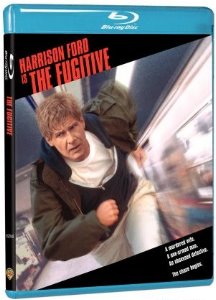
The Fugitive [Blu-ray]

(Andrew Davis, 1993)


The Score Card : BD/SD

The Movie : 8.0

I'm off the hook about comparing the movie to the TV show, having only seen the odd episode (it was a time of competing priorities.)  But taking it on its own, the movie is a well paced thriller, with extended action sequences and suspenseful trips to the hospital for the hero to "re-enter his life" and find the whereabouts of the missing prosthetic arm.  The chemistry between Harrison Ford and Tommy Lee Jones as Dr, Richard Kimble and U.S. Marshal Samuel Gerard (who sort of start off as contemporary versions of Jean Valjean and Inspector Javert) is a joy.  Even though they do not share the screen for most of the time, we feel the rapport grow as Gerard gradually takes hold of the truth.

Nearly all the supporting characters are well cast and dynamically presented, from Sela Ward as Kimble's wife in her very few fond and wistful moments with Ford, to the ever-complaining Joe Pantoliano as Deputy Marshal Renfro, Jeroen Krabbe as Kimble's respectful colleague, and Andreas Katsulas as the professional one-armed man ("How did you lose your arm?  "In the line of duty," he replies carelessly and disdainfully.)  Julianne Moore, who received a billing far above her importance in the film, was wasted in what was apparently conceived as the scene that was supposed to set our minds to rest about Dr. Kimble's true nature.  ("He saved his life," Moore's Dr. Eastman replies to Gerard's query about how the boy was doing that Kimble redirected to the proper emergent care.)

Besides the minor bit of misdirection when the marshals listen to a taped conversation between Kimble and his attorney, which repositions the background train and bell sounds differently from the way we saw and heard them, my problem with the movie has always been that I have never found a convincing explanation of what the perpetrators were going to do on that fateful night and how they were going to do it.  (They had the key, but no security code; Was the one-armed man waiting for hours for Kimble to come home?  Where – and was this the plan? Who was the intended victim – with only one arm and no weapon?)  Plotholes aside, I continue to find The Fugitive rewatchable.

Image : 8.0

The Fugitive is still in fine shape: sharper in most places than I expected it to be.  Made almost fifteen years ago before digital effects became the norm for dramatic thrillers and when they still had much the same look as they had since The French Connection twenty years earlier, The Fugitive is your basic drama, except with more lighting.  I assume this allows it to play better on television, as it ensures greater visibility, depth of field and clarity of focus at nearly all times.  The Fugitive is meant to be smart and clever, like its protagonist. Watched in high definition, the use of extra artificial lighting shows up, sometimes obtrusively.  We don't notice it when the image is blown up to the size of a theatrical screen, but at home, the contrast is sometimes excessive.  And it's true for most movies that use auxiliary lighting, usually at the sides and behind, to help set off one character or object from another.  There's not a whole lot that can be done about it for home video, for how would screen size be factored in?  (See more on image comparisons in the following paragraph.)

Empathy : 9

Once again, the difference between the standard and high definition discs, while not something that knocks one's socks off in an A/B comparison, is more felt that observed.  Difference in resolution, sharpness, color contrast and brightness are obvious, but we can get used to a 480p presentation by inertia and the seductive power of the medium.  But the difference in emotional involvement is significant.  In its own terms, it is roughly equivalent to quadrupling the screen size while maintaining resolution.  Our sense of space opens up on the BD disc.  We might not even have been aware that it was so flat on the SD.

Audio : 8

We think immediately of the astonishing train wreck: the screeching of metal against metal, the attempt at braking what will shortly be crashing tons of engine and freight as they crushes through the hillside.  The images support the audio and vice-versa.  There's not much more here to show off one's audio system in this movie: some nice helicopter effects and the tunnels and falling water around the dam, traffic sounds: everything works well to support the place and mood.  For a thriller, The Fugitive is relatively subtle in respect to its audio.  Mainly what we want is atmosphere, clear dialog, and a great train wreck.  And we get it.

Operations : 8

Typical of Warner Blu-ray discs, the film begins almost immediately after loading, without having to get permission for the main menu.  The menu, when accessed, is remarkable for it very unoriginality, which is so much the better in this case.  Both BD and SD discs have the same number of chapter stops.  The SD has larger thumbnails with captions.  The BD has the same thumbnails, smaller, without captions, but the images chosen make for useful cues for the scene.

Extras : 8

The extra features are the same as on the SD disc: most important are two documentaries: Derailed: Anatomy of a Train Wreck and On the Run with The Fugitive, and a chatty commentary between the director, Andrew Davis, and Tommy Lee.

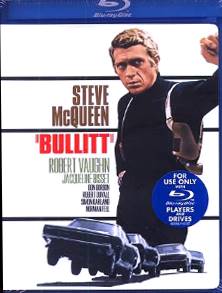
Bullitt [Blu-ray]

(Peter Yates, 1968)


The Score Card : BD

The Movie : 8.5

Bullitt is a police drama complex enough to make it fresh on repeated viewings.  Unlike Harry Callahan, Detective Frank Bullitt is a respected, no nonsense police officer with a great public image.  He is handpicked by Walter Chalmers - a political hack, currently leading an investigation into organized crime - to protect his star witness.  In due course, the witness gets whacked.  Bullitt wants to know why.  Chalmers just wants to shift the blame. 

McQueen's Bullitt is the personification of cool, like his Thomas Crown (the same year), with a gun and a Ford Mustang GT390.  The Mustang's nemesis is a black Dodge Charger 440 R/T.  When the bad guys in the Charger try to follow and ambush Bullitt, he suddenly appears in their rear view mirror: one of the great visuals in cinema.  Lalo Schifrin's jazzy score sets the tone for some while before it quits in favor of the sound of engine revs and whacked cars. Perhaps I'm getting old, but I had to avert my eyes during a couple of the G-force drops to avoid getting sick.  More than your typical stunt-filled computer-enhanced thriller of the last few years, this movie absolutely must be seen on as large a screen as possible for that genuine sinking feeling. 

Schifrin's music perfectly sets the tone is right at the outset of the movie, even before we see an image (coincidentally, a night view of Chicago.)  Visually, this is my favorite part of the movie, as the titles give way to alternating black & white and color images of cat & mouse danger.

There is one less than convincing scene when Bullitt's girlfriend, played by a breathtakingly beautiful Jacqueline Bissett, confronts him with a speech about how she doesn't believe he could not become part of the sewer he spends his life in.  We wait for him to say, "But someone has to do it."  Happily, he doesn't, and thus retrieves what could have been a wretched moment.  The scene does play in the same kind of matter of fact tone that most of the film works in, so there's that going for it.  But Bissett sounds like she's reading lines prepared by a campaign manager.  When Chalmers does that sort of thing – which he does often, Robert Vaughan brings it off with great slime, but Bissett may be the wrong choice to make the speech.  Perhaps I find her too sweet for the part. For all her grousing, Bullitt stops long enough during the great chase to make sure that help was at hand for a downed motorcyclist.  Perhaps she should have known her man better, but I give her some slack for having just witnessed her first homicide.

Image : 5.0~7.5

Bullitt was filmed before there were dramatic breakthroughs in film and lens technology that would permit photography in low light situations without the kind of grain that persists in some of the shots here.  (I'll bet the producers just loved that!)  The image of Bullitt is often meant to be gritty, even murky, like its subject matter.  The BD and 2-Disc Special Edition SD appear to have been transferred from the same high definition master, so we're getting what is likely to be the best possible transfer for some while to come.  The movie is generally grainy, though sharp.  Daylight scenes, dramatically sharp.  Night scenes, especially outdoors, often appear unaided by supplementary lighting, which gives the picture a realistic, though sometimes impenetrable look.  Some of the early scenes (where Lt. Bullitt first meets Chalmers and at the Coffee Cantata) may have looked OK on the big screen, but the auxiliary lighting looks unconvincing on front projection . . . probably even more so on plasmas.

Even though Bullitt was made some 25 years earlier than The Fugitive, the black of the sky is rendered blacker for all but two or three brief cuts during the chase on the airport tarmac. These, like the opening shot of Chicago at night in The Fugitive are speckled with flecks indicating an unnatural brightening of the scene in an ill-considered attempt to "improve" overall illumination.  The contrast between such segments and the adjacent frames where the sky is pitch black is jarring in BullittThe Fugitive follows the "overdeveloped" shot with a deliberately grainy indoor shot so we don't notice the glitch when we return to a proper black night immediately after.

We might think that a movie whose film stock is "compromised" as much as Bullitt would make a poor candidate for a high-def presentation.  This might be true if your intent is merely to show off how cool your video display is.  But if you were to watch the BD edition of Bullitt in its entirety and then scan a few scenes in SD, you might wonder how you could sit through it at 480p on a large screen: The scenes have very little dimension.  Even in the daytime shots, your scaler will be working overtime trying to sort out what is grain and what is blue sky or a stone building.  I have a good one and yet the image quivers with digital guesswork.  Not so on the Blu-ray, which hums along with nary a squawk, once we get used to the limitations and benefits of the film stock.

Not that we make decisions to watch or own based on such things, but the cover mislabels the aspect ratio as 2.4:1.  The picture is really 1.85:1, just as it should be.

Empathy : 9

As noted above with The Fugitive, the difference between the standard and high definition discs, while not something that knocks one's socks off in an A/B comparison, is more felt that seen.  Difference in resolution, sharpness, color contrast and brightness are obvious, but we can get used to a 480p presentation by force of habit and the seductive power of the medium.  But the difference in emotional involvement is significant.  It is roughly equivalent to quadrupling the screen size while maintaining resolution.  Our sense of space opens up on the BD disc.  We might not even have been aware that it was so flat on the SD.

Audio : 6

The music and dialog is clear enough, but if you close your eyes during the car chase, you will be surprised by how flat and compressed it is.   The visuals more than make up for the lack of audio dynamics.

Operations : 5

The film begins shortly after loading following a brief stop at the FBI warning and the Warner Home Video logo.  The menu has what I feel is a major flaw: the commentary can only be accessed in the Special Features section, and from there, the soundtrack can only be accessed via the Languages menu.  This is idiotic as well as damn inconvenient.  Why not use the Audio function: everybody else does, nearly? Moreover, when Yates refers to the soundtrack, said soundtrack does not come to foreground as it should, and remains nearly inaudible.

Extras : 8

The VC-1 coding of Bullitt manages to fit onto one disc all of the Special Features found on the SD 2-disc Special Edition DVD: an informative running commentary by director, Peter Yates, originally recorded for the SD edition; a 10 minute short titled Steve McQueen's Commitment to Reality; and two 90 minute documentaries: Steve McQueen: The Essence of Cool and The Cutting Edge: The Magic of Movie Editing - the latter in very nice 1080p no less, is about editing in general, though it features the famous car chase.  Bullitt, no surprise, won the Oscar for film editing, and rightly so.

Leonard Norwitz
LensViews
June 26th, 2007

COMING SOON:
Pirates of the Caribbean: Curse of the Black Pearl
Pirates of the Caribbean: Dead Man's Chest
Curse of the Golden Flower
Good Night, and Good Luck
The Searchers
The Queen
Unforgiven
Casino Royale
Enter the Dragon
Kung-Fu Hustle
Rocky
Reds


Hit Counter