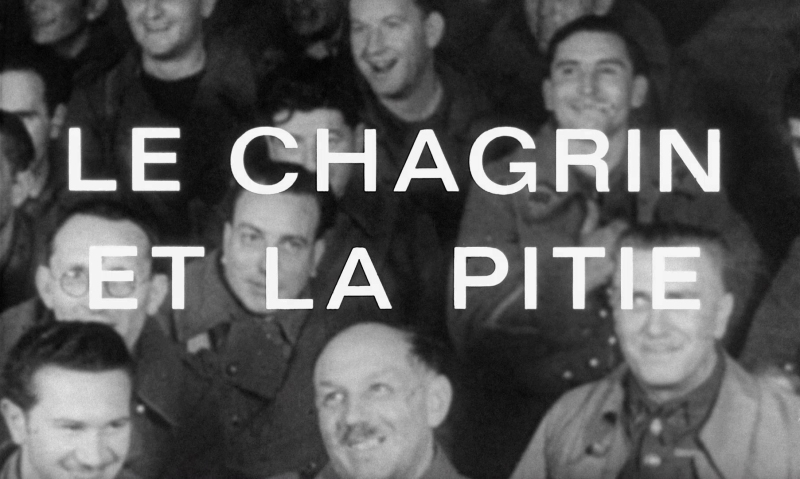
directed by Marcel Ophuls
review by Gary Tooze

“The Sorrow and the Pity”, made in 1969, is a 4 hour documentary ( taken from 80 hours of footage ) directed by Marcel Ophuls, son of the frequently admired director Max Ophuls. It deals with the occupation of France by Nazi Germany in WW2 from 1940 –1944 and the inherent problems associated in social and political interactions on both a personal and national level. France was “overtaken” by Germany in 42 days in spite of the fact that France had the largest army in the entire world. Due to political indecision or public perception thereof the occupation and eventual armistice caused much internal strife considering, or perhaps because of, it being a generally non-violent takeover. This perception of a struggle with little fight left many Frenchman both embarrassed and politically divided. Anti-Semitism, Anglophobia, Homophobia as well as anti-communism and anti-nazism and their corresponding counterpart beliefs all rose to the surface with strikingly divergent viewpoints.

Ophuls focused many of his interviews on residents of a small French city, Clermont-Ferrand that is eventually seen as a microcosm of the entire country. Discussions with residents include political stances, both past and present and overall effects of the occupation even 40 years later. With historical footage culled from archival newsreels and clips of newspaper headlines Ophuls sets the tone subtly in the first half of his two-part documentary. The 2nd half takes a more hard-lined interpretive stance as many of those interviewed relate personal anecdotes on how the political climate affected them. Disturbing incidents are related in a frank fashion as previous interviewees are revisited as a new topic is brought to the forefront.

For history buffs this is a
truly fascinating film, imbedding deeply the often unspoken and unseen affects
that Germanys military sweep through Europe had made on the entire country of
France, this small city and many of the individuals who lived there before
through and after the occupation. It is a lesson in appreciating opinions of
actions that we may have interpreted differently and appreciation of the
long-term effects of this particular incident in history through personal
stories of farmers, journalists, WW1 veterans, collaborators and members of the
Resistance. This group included Pierre Mendès-France, jailed for anti-Vichy
action and later becoming France's Prime Minister.
I recommend this DVD to everyone who will devote the time to viewing it that it so richly deserves, but I especially recommend it to fans of History and WW2.