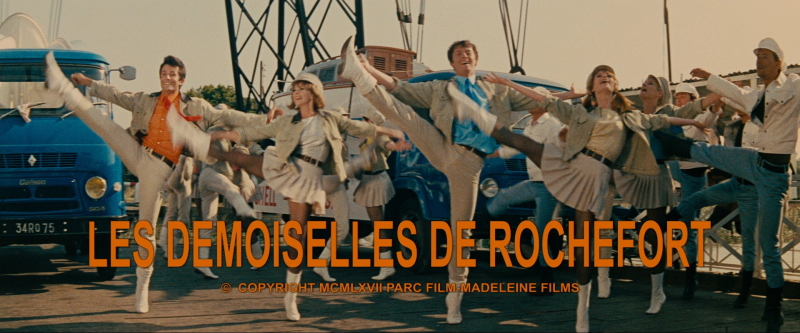
(aka "The Young Girls of Rochefort" or "Les Demoiselles de Rochefort" )


directed by Jacques Demy
France 1967


Most musicals shift back and forth between story (spoken dialogue) and song-and-dance numbers--sometimes creating queasy transitions just before or after these shifts, when we're uncertain where we are stylistically. But The Young Girls of Rochefort often daringly places story and musical numbers on the screen simultaneously, mixing them in various ways and in different proportions. One of the stars may be walking down the street, for example, but the pedestrians around her are suddenly dancing, and she slips momentarily in and out of their choreography. This curious mix produces powerful, deeply felt emotions--an exuberance combined with a sublime sense of absurdity, shot through with an almost constant sense of loss, yearning, and even tragedy. Yet the coexistence of this strangeness and this intensity will inevitably make some American viewers laugh in disbelief and regard the whole spectacle as an esoteric piece of camp. (The same problem exists to a lesser extent in two of my favorite American freak musicals, Love Me Tonight and Hallelujah, I'm a Bum, both of which display a related metaphysical impulse to perceive the musical form as a continuous state of delirious being rather than a traditional story with musical eruptions.)

[...]

Masterpieces normally connote perfection, but it might be argued that some of the imperfections in The Young Girls of Rochefort enhance the overall experience by bringing it closer to life, making the actors seem more vulnerable. (Other imperfections, like the product plugs during the climactic fair--another parallel with Playtime, given some of its neon signs--are simple reminders of the difficulties of making big-budget French movies.) Darrieux, for instance, is the only cast member who does her own singing, though the dubbing of the others is usually carried out well, with the actors' singing voices carefully matched to their speaking voices (including Kelly's spoken French). More artificial are Delphine's and Solange's performances on trumpet and flute. Yet given some of Demy's original plans for the movie, it's a miracle it turned out as well as it did. Before he selected Rochefort as his location, he considered making "Les demoiselles d'Avignon," "Les demoiselles d'Hyeres," "Les demoiselles de Toulouse," and "Les demoiselles de La Rochelle," among others. Rochefort won out because of the size of its central square, though production designer Bernard Evein found it necessary to repaint 40,000 square meters of the city's facades. (Still, director Andre Techine has cited the movie as one of the best ever made about this part of France.) Even more improbable, Demy originally thought of casting Brigitte Bardot and Geraldine Chaplin as the twin sisters.

Excerpts from Jonathan Rosenbaum's Review in the Chicago Reader HERE

Poster

Theatrical Release: March 8th, 1967

Reviews    More Reviews  DVD Reviews

DVD Review: Miramax - Region 1 - NTSC

DVD Box Cover

CLICK to order from:

Distribution

Miramax

Region 1 - NTSC

Runtime 2:04:46
Video

2.35:1 Original Aspect Ratio

16X9 enhanced
Average Bitrate: 3.91 mb/s
NTSC 720x480 29.97 f/s

NOTE: The Vertical axis represents the bits transferred per second. The Horizontal is the time in minutes.

Bitrate

Audio Dolby Digital 2.0 (French)
Subtitles English, none
Features Release Information:
Studio: Miramax

Aspect Ratio:
Widescreen anamorphic - 2.35:1

Edition Details:
• Sneak Peeks

DVD Release Date: January 22nd, 2002
Keep Case

Chapters 21


Comments:

Miramax presents Jacques Demy's eternally beautiful "The Young Girls of Rochefort" in the restored version that graced US movie theatres in 1998.

The image is almost flawless. Demy's sparkling pop colors are pristinely preserved and the picture has just the right amount of grain. (Ed. - there are instances of artifacts and haziness and I can't help but think this would be vastly improved with a better compression transfer or especially if it ever makes it to hi-def).
 

As for the sound, the French Dolby Digital 2.0 track does everything right. Both dialogue and Michel Legrand's fabulous score are perfectly audible.

There are no extras here, but at least Miramax made the English subtitles optional.

 - Stan Czarnecki


DVD Menus


Screen Captures


Subtitle sample


DVD Box Cover

CLICK to order from:

Distribution

Miramax

Region 1 - NTSC


Hit Counter

DONATIONS Keep DVDBeaver alive and advertisement free:

Mail cheques, money orders, cash to:    or CLICK PayPal logo to donate!

Gary Tooze

1775 Rowntree Court

Mississauga, Ontario,

L4W 4V3    CANADA

Thank You!