![]()
![]()
![]()

(aka 'Black Irish' or 'Take This Woman' or 'The Girl from Shanghai')

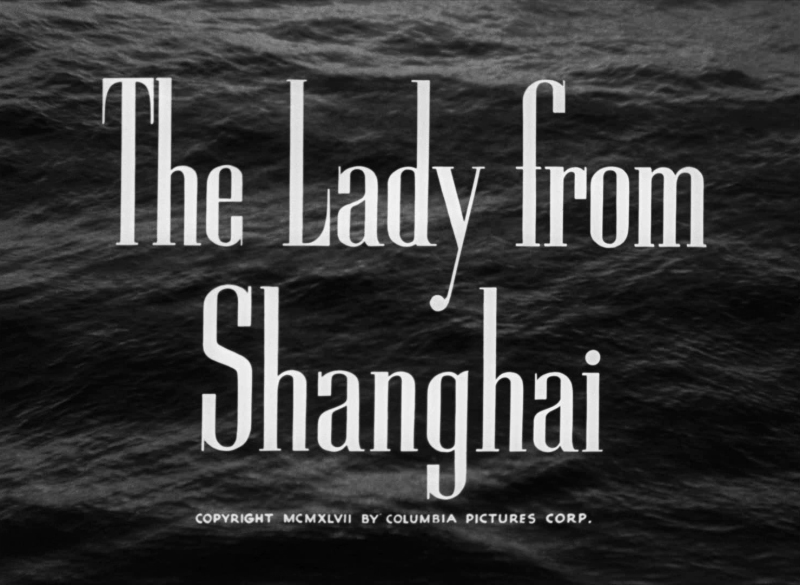
The Lady from Shanghai (1948) is a complex film noir with subtle plot
twists and magnificent directorial techniques. After doing some research I found
the most plausible explanation of the Welles character, Michael O'Hara, was that
it mirrored himself to a certain extent ( “rejoicing in being eccentric and
poor” ). Michael is a closet author who was too principled to be swayed by
money. The same mind-set influenced much of Welles career as a director; his
artistic integrity in battling with the studios etc. Throughout the Lady from
Shanghai, especially in the courtroom scenes, Welles depicts lawyers in a very
negative sense. This too, mirrored his personal sentiments. Welles starred in
this film with his then wife, the gorgeous, but personally troubled Rita
Hayworth ( playing Elsa Bannister ). The couple’s troubles reconciled during the
production of the film, but they divorced before it ever opened.
Orson Welles wrote this screenplay an adaptation of a Sherwood King novel. He
had great difficulty getting it past Joseph Breen, the overseer of the Motion
Picture Production Code, and in the end had to drop the ending and approximately
1 extra hour of film with, among other things, O'Hara persuades Elsa to kill
herself. Much of what was cut from the final version was more in depth
adventures within the amusement park, perhaps showing more symbolism as Welles
himself would stay up all night painting the wooden clowns etc.
My favorite symbolism ( albeit totally unsubtle ) is where the judge is seen as
a shadow on the window playing chess through the reflection. In essence the
manipulation of the defendants and perhaps the entire court, being manipulated
by his judgment.
I would compare this closely to Welles “The
Stranger” with Edward G. Robinson. There are some stunning
visuals in both film; the clock tower in The Stranger and the Amusement hall of
mirrors in Lady From Shanghai. Welles, although not totally divorcing himself
from The Stranger, felt it was the film with “the least of himself as a
director”. I, personally loved the Stranger and this film, probably mostly for
the genre and the visual magic with attentive Wellesian dialogue.
This certainly not being
Citizen Kane and therefore not perfect
Welles, I would say even his “B” list of projects outclasses most other
directors. Since I love the
film-noir and mystery genre I must give
this film the high rating I feel it deserves.
out of
Posters
![]() |
![]() |
![]() |
![]() |
![]() |
![]() |
![]() |
![]() |
![]() |
Theatrical Release: December 24th, 1947
Reviews More Reviews DVD Reviews
DVD Review: Columbia Tri-Star - Region 1, 3, 4 - NTSC
| DVD Box Cover |
|
CLICK to order from: |
| Distribution | Columbia Tri-Star Home Video - Region 1, 3, 4 - NTSC | |
| Runtime | 1:27:421 | |
| Video | 1.33:1
Original Aspect Ratio Average Bitrate: 4.98 mb/s NTSC 720x480 29.97 f/s |
|
|
NOTE: The Vertical axis represents the bits transferred per second. The Horizontal is the time in minutes. |
||
| Bitrate: |
|
|
| Audio | English (Dolby Digital 2.0), DUBs: French (Dolby Digital 2.0), Spanish (Dolby Digital 2.0), Portuguese (Dolby Digital 2.0) | |
| Subtitles | English, French, Spanish, Thai, Portuguese, Chinese, Korean, None | |
| Features |
Release Information: Edition Details: • Audio
Commentary by Peter Bogdanovich |
|
| Comments: |
This was in the early days of DVD when Columbia ruled the roost. They put an immense amount of effort into their DVD productions (see "The Big Heat" as another example) and sadly now that has changed. This is as close to perfect DVD as you will find. The image is marvelous - extremely sharp, deep blacks and superb shadow detail. The original audio is crisp. My only gripe, and it is a small one, - I have never liked the bright yellow (and overly large) subtitle font. That is my only complaint.
Obviously made to sell in
other markets this DVD is filled with subtitle and DUB options and is
encoded for regions 1, 3 and 4 in the NTSC standard. It not only
includes a commentary by Welles scholar Peter Bogdanovich, but also a 20
minute featurette conversation with him, some talent bio text screens,
trailers and some vintage advertising stills. DVDBeaver encourages you
to pick up this and all those early Columbia DVDs
when that studio seemed
to be more keen on investing some real effort into their discs than they
are now. This is a must-own DVD.
|
DVD Menus
![]() |
![]() |
![]() |
![]() |
![]() |
![]() |
Subtitle Sample
![]() |
Screen Captures
![]() |
![]() |
![]() |
![]() |
![]() |
![]() |
![]() |
![]() |
Associated Reading (CLICK COVERS or TITLES for more information)
![]() |
![]() |
![]() |
![]() |
![]() |
![]() |
![]() |
![]() |
|
This is Orson Welles by Orson Welles, Peter Bogdanovich, Jonathan Rosenbaum |
Orson Welles on Shakespeare: The W.P.A. and Mercury
Theatre Playscripts by Orson Welles, Simon Callow, Richard France |
Orson Welles: Interviews (Conversations with
Filmmakers (Paperbacks)) by Orson Welles, Mark W. Estrin |
The Trial by Franz Kafka |
Orson Welles : The Stories of His Life by Peter Conrad |
Rosebud : The Story of Orson Welles by David Thomson |
Encyclopedia of Orson Welles (Great Filmmakers) by Chuck Berg, Tom Erskine, John C. Tibbetts, James M. Welsh, Thomas L. Erskine |
Chimes at Midnight: Orson Welles, Director (Rutgers
Films in Print) by Bridget Gellert Lyons |
| DVD Box Cover |
|
CLICK to order from: |
| Distribution | Columbia Tri-Star Home Video - Region 1, 3, 4 - NTSC | |
![]()
![]()
![]()
DONATIONS Keep DVDBeaver alive and advertisement free:
Mail cheques, money orders, cash to: or CLICK PayPal logo to donate!
|
Gary Tooze 1775 Rowntree Court Mississauga, Ontario, L4W 4V3 CANADA |
|
Thank You!