
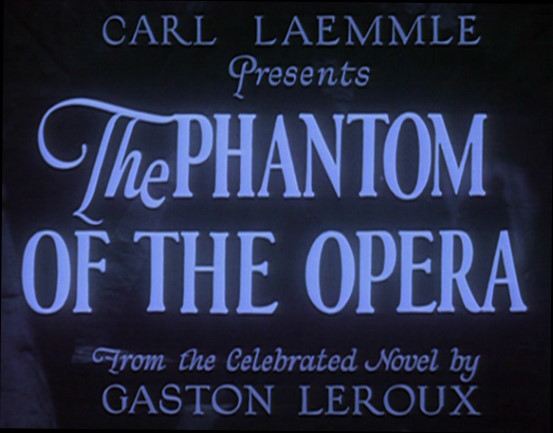
![]()
![]()
directed by
Rupert Julian
USA 19
Beneath the splendid
riches of the Paris Opera House lie ancient catacombs with a dark and
forbidden secret. These vast underground rooms and hidden passages were once
used as torture chambers to satisfy the blood lust of a crazed population.
Rumors abound that the Opera Ghost lives there still, vowing vengeance on the
human race.
When film director Rupert Julian was presented with the script for The
Phantom of the Opera, he declared simply: "Lon Chaney, or it can't be
done!" For the film, "the man of a thousand faces" transformed himself into
his most recognizable character. Using chemicals to dilate his pupils, cotton
and celluloid discs to heighten his cheekbones, fanged teeth to create a
horrific grin and wires to pull his nose upwards, Chaney became the menacing
Phantom who lurks in Box 5 of the Opera - and in the dark cellars below.
This spine-tingling, macabre masterpiece can now be viewed in all its grand
guignol glory. Using the finest restored 35mm print of the 1929 reissue, and
materials from archives around the world, and employing the latest in digital
technology, Photoplay Productions created a stunning video master featuring a
magnificent orchestral score by composer Carl Davis (Napoleon). The Photoplay
team was also able to restore the stunning Technicolor bal masque sequence and
has painstakingly re-created the Handschiegl color process used in the famous
"Apollo's Lyre" scene on the roof of the Opera.
******
The 1925 silent film "The Phantom of the Opera" starring Lon Chaney
stands as the best argument against remaking classics. Since its release, there
have been five official remakes (a sixth, based on the Andrew Lloyd Weber
musical, is currently in the works) which brought to the screen everything that
the original lacked: color, music, a higher level of sadistic violence, and more
sophisticated special effects. But none of these remakes came close to capturing
the genuine sense of horror in the original version, which is widely regarded as
being among the finest films ever created.
Yet "The Phantom of the Opera" itself has come down through the years
rather worse for the wear. The problems began four years after its release, when
Universal Pictures decided to cut 10 minutes from the footage and add new
footage (including a prologue with a weird man holding a lantern in a dark
catacomb) plus a new soundtrack that would take advantage of the new push to
talking pictures. One major problem with this was the absence of Lon Chaney, who
was then under contract at MGM and could not add his voice to the film. The
solution, if you could call it that, was to leave the Phantom's voice off the
soundtrack. Inexplicably, the soundtrack was lost over time yet this reissued
version became the accepted standard version. The 1925 version survived, but the
extant prints deteriorated to the point that they were rarely screened; many
scholars mistakenly believed this version was lost. In 1953, Universal stupidly
neglected to renew the film's copyright and "The Phantom of the Opera" lapsed
into the public domain, resulting in a flood of badly duped prints that became
commonly seen on TV broadcasts and cheap videos.
Excerpt from Phil Hall's review at Film Threat located HERE.
Posters
![]() |
![]() |
![]() |
![]() |
![]() |
![]() |
![]() |
![]() |
![]() |
![]() |
Theatrical Release: September 6th, 1925
Reviews More Reviews DVD Reviews
DVD Review: Image Entertainment (Milestone Collection) - Region 1 - NTSC
| DVD Box Cover |
The Phantom of the Opera - The Ultimate Edition (1925 Original Version and 1929 Restored Version) (1925) |
CLICK to order from: |
| Distribution | Image Entertainment (Milestone Collection) Home Video - Region 1 - NTSC | |
| Runtime | 1929 - 1:34:42 / 1925 - 1:46:56 | |
| Video | 1.15:1
Original Aspect Ratio Average Bitrate: 1929 - 7.3 mb/s / 1925 - 7.0 mb/s NTSC 720x480 29.97 f/s |
|
|
NOTE: The Vertical axis represents the bits transferred per second. The Horizontal is the time in minutes. |
||
| Bitrate: |
|
|
| Bitrate: |
|
|
| Audio | 1925 - Silent - Carl Davis orchestral score (Dolby Digital 2.0) , 1929 - minor dialogue talkie (Dolby Digital 2.0) | |
| Subtitles | None | |
| Features |
Release Information: Edition Details: • Commentary
by film historian Scott MacQueen
Double thick k |
|
| Comments: |
2 disc - one with the restored 1929 version and the 2nd with the original (and longer) 1925 version. Well, I've read quite a bit on these two releases and the processes that went behind the newer 1929 edition, and I can't say I am all for it, although it is impossible to deny that this restored version is the best that the Lon Chaney classic will ever look. I guess although we can be dyed-in-the-wool artistic protectionists that the 1929 version was extensively created over 75 years ago - but even in that sense we have a bit of a mish-mash put together far after-the-fact. I, in no way, mean to ignore the great detail and research that went into the piece-meal creation of this 1929 edition and this is much akin to Lang's Metropolis in that respect. Unfortunately footage or audio is lost forever and we should be thankful that we have anything at all. Considering the age and elemental history this Image DVD showcases the 1929 restored version looking absolutely magnificent. Of course not perfect with much flickering contrast and some unavoidable damage marks but the Carl Davis track sounds pristine and the entire film gives a bona-fide 'step back' sense. I would compare this to Image's Les Vampires, for that same intrinsic historical 'feeling' of being in a theatre patron of over half a century ago. It has what might appear to be ghosting but I can only assume this has to do with frame rate conversion. I am also grateful that the original 1.15 aspect ratio has been preserved in both editions. Unfortunately, the
original 1925 edition (on disc 2) has been treated like a poor cousin
and has not been transferred progressively. 'Combing' can be seen in
many instances (see last large capture) which only adds to its extremely
ill-lit and damaged appearance. Still the mere addition of this release
is a testament to the respect Image has shown the film. Film students
could spend hours comparing and calculating the additions and
deletions... in fact you can't really 'not' do it yourself. With all the
abundant extra features, including a commentary, this is a must-own
digital release showcasing the only worthy versions of this
magnificently crafted story. We strongly recommend!
|
![]() |
![]() |
![]() |
![]() |
![]() |
![]() |
DVD Menus
(Disc 2 - 1925 version)
![]() |
![]() |
![]() |
![]() |
![]() |
![]() |
Intertitle Sample
1929 Restored version TOP vs. 1925 Original Feature Version BOTTOM
![]() |
![]() |
Screen Captures
![]() |
1929 Restored version TOP vs. 1925 Original Feature Version BOTTOM
![]() |
![]() |
![]() |
1929 Restored version TOP vs. 1925 Original Feature Version BOTTOM
![]() |
![]() |
![]() |
![]() |
![]() |
![]() |
|
|
| DVD Box Cover |
The Phantom of the Opera - The Ultimate Edition (1925 Original Version and 1929 Restored Version) (1925) |
CLICK to order from: |
| Distribution | Image Entertainment (Milestone Collection) Home Video - Region 1 - NTSC | |
![]()
![]()
![]()
DONATIONS Keep DVDBeaver alive and advertisement free:
Mail cheques, money orders, cash to: or CLICK PayPal logo to donate!
|
Gary Tooze 1775 Rowntree Court Mississauga, Ontario, L4W 4V3 CANADA |
|
Thank You
!