
![]()
![]()
![]()
![]()
(mouse over title to see Image Entertainment DVD version)
(aka 'Dr. Mabuse, King of Crime" or "Dr. Mabuse: The Gambler" or "Inferno")

Dr Mabuse The Gambler is a fascinating reflection of German society in the 1920s and all its criminal-ridden decadence. In Fritz Lang's epic tale of domination by terror, the power-crazed Mabuse (Rudolph Klein-Rogge) masterminds the world's most dangerous gang of counterfeiters, thieves and murderers, wielding hypnotic powers with an iron fist to obtain total obedience to his will! This double DVD set presents the complete 4 1/2 hour version of Lang's silent masterwork.
out
of
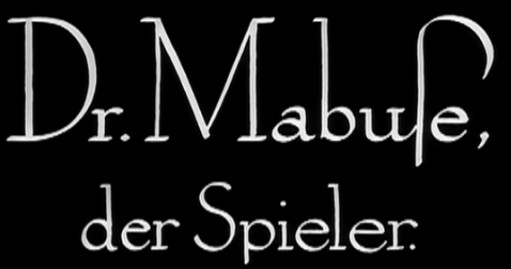
The two-part film Dr. Mabuse, der Spieler
(Dr. Mabuse, the Gambler) is one of the most sensational crime thrillers
ever filmed. It is also, together with Die Nibelungen, Metropolis,
and M, one of Fritz Lang’s most accomplished films.
It mirrors German society of the 1920s in all its criminal-ridden decadence. Its
sinister theme is domination by terror. The power-crazed Mabuse masterminds the
world’s most dangerous gang of counterfeiters, thieves, and murderers, wielding
hypnotic powers with an iron fist to obtain total obedience to his will. A
master of many disguises, Mabuse is portrayed by Rudolf Klein-Rogge, who later
starred as Rotwang, the mad scientist, in Lang’s science-fiction classic,
Metropolis. See the cinema’s most legendary criminal genius in this monumental
four-hour epic.
Posters + Video jackets
![]() |
![]() |
![]() |
Theatrical Release: April 27th, 1922 - Germany
Reviews More Reviews DVD Reviews
DVD Comparison:
Kino - Region 0 - NTSC vs. Image Entertainment - Region 1 - NTSC vs. Eureka - Region 2 - PAL
Big thanks to
Gregg Ferencz, Enrique B Chamorro and Nick Wrigley for the Screen Captures!(Kino - Region 0 - NTSC LEFT vs. Image Entertainment - Region 1 - NTSC - MIDDLE vs. Eureka - Region 2 - PAL - RIGHT)
| DVD Box Covers |
|
|
|
| Distribution |
Kino Region 0 - NTSC |
Image Entertainment Region 1 - NTSC |
Eureka Region 2 - PAL |
| Runtime | Approx - 4.5 hours | 2:00:16 + 1:49:24 = 3:49:40 | Approx - 4.5 hours (4% PAL speedup) |
| Video |
1.33:1
Original Aspect Ratio Average Bitrate: 6.29 mb/s NTSC 720x480 29.97 f/s |
1.25:1 Aspect Ratio |
1.30:1
Aspect Ratio |
|
NOTE: The Vertical axis represents the bits transferred per second. The Horizontal is the time in minutes. |
|||
| Bitrate:
Image Entertainment
|
|
||
| Audio | Dolby Digital 2.0 - Music Score | German (Dolby Digital 2.0 Mono) |
German (Dolby Digital 1.0 Mono) |
| Subtitles | Non removable English | German Intertitles replaced with English Intertitles | English, French, None |
| Features |
Release Information: Studio: Kino Aspect Ratio: Edition
Details:
•
Fritz Lang bio/filmography Chapters 30
|
Release Information: Studio: Image Ent.
Aspect Ratio: |
Release Information: Studio: Eureka Video Aspect Ratio: Original aspect Ratio 1.30:1
Edition Details:
° German Intertitles |
| Comments: |
ADDITION: - Kino - Region 0 - NTSC - July 06' :
- The new Kino edition appears to be from the same source
as the Eureka release, including the use of English intertitles,
probably a result of the restoration process. There are a few
noticeable differences between this version and the Eureka
release. One is the non removable English subtitles over
shots of German text (see capture #7). Another difference is
that the contrast on the Eureka version is boosted resulting in
increased sharpness and deeper blacks. However, the smoother
Kino image displays better gray scale and, in most cases,
reveals more image detail (capture #4 is an exception). I
noticed some combing artifacts during the screen capture process
indicating a non progressive transfer. No surprise coming from
Kino.
"I imagine you will get around to the new Kino Dr. Mabuse that just came out. It is the Transit Films version clocking at 4.5 hours, and it is tremendous, a vast improvement over the Image version, both in image quality and (I believe) in correct speeds (almost anything David Shepard touches seems to me played too fast). However, Kino somehow managed to botch the brightness/contrast levels. To see this most clearly, watch the extras on Disc 2, for example the one about the music. If you play it with a normal brightness setting, the clips look wonderful, but if you watch the same parts during the DVD proper, you will see they are much brighter with things looking very washed out. Even if you don't make such a comparison, the Kino transfer is transparently wrong anyone would see it as too bright. I found when I lowered my brightness control 10 units (out of 60) below my normal setting, I was able to get a satisfactory image. There were still some problems - faces of characters in a medium or long shot tended to look a bit washed out, but I don t know if the contrast setting would have helped, or if the problem is in the source. Anyway, please blast Kino for botching what should have been an easy transfer, since they had a superb source there was no excuse for getting the brightness/contrast wrong."Louis
Irwin (sent to us in email) Just to add my own opinion - I suspect there are only a handful of people who 'know' what this release should look like - so after that it depends on personal preference. I think the Kino has had some brightness boosting - I think the Eureka has had some black-level boosting. One removes damage marks the other heightens sharpness. From the captures I like the softer look of the Kino. I am still waiting for my copy to arrive. What bothered me about the Eureka was the audio - so I will post again after I get, and watch, my Kino version. The other issue I am still working on is the time - is the Kino taken from a PAL source? or the Eureka from an NTSC source? - I suspect the former and the 'combing' Gregg noticed may be from incorrect standard transfer. More will be added to these comments as we can derive answers. At least now you can visually see the differences. Overall the Kino release would be considered a triumph for that distribution company (and their past record). NOTE: We thanks Gregg for supplying the new Kino captures! Gary Tooze **** THE IMAGE DISC: The back jacket comments state that the transfer was made from a fine grain master and is at the correct speed. David Shepard takes great care in his releases. Perhaps much of the timing differences stem from the time the camera stays on the inter-title for the viewer to read. We are investigating.
The Image Entertainment release is not the 'full version' (4.5 hours). It has spots where it appears zoomed in, contrast has been boosted and it is no where near the sharpness of the new Eureka disc. The Image Entertainment does have a commentary which is a bonus for real fans. Obviously we lean toward the Eureka DVD in this case. The disparity in image quality, original inter-title cards and the completeness of the PAL version are the swaying factors.
THE EUREKA DISC:
Whilst agreeing
wholeheartedly with you that the visuals are superb - well up to the
standard that we’ve come to expect from Eureka lately, the English
subtitles rather let the side down. Apart from the odd spelling
mistake, they bear the unmistakable sign of being translated by
someone who is not a native English speaker. From the constructions, I
would hazard a guess that they were done in Germany.
I know that this could
be regarded as nit-picking, but there are a couple of places where
things just don’t make sense. So
Stephen Gadd As with
other recent Eureka silent releases, this is stunning. Beautifully done
with care and detail - crammed with Extras - a sharp image with film
grain. Whatever digital processing method they are using is so
gratifying for the fans of silent films. What can you say except -
Magnificent job Eureka !
|
Associated Reading (CLICK COVERS or TITLES for more information)
![]() |
![]() |
![]() |
![]() |
![]() |
![]() |
![]() |
![]() |
|
Movie Posters of the Silent Film Era To Color by Rex Schneider, Christopher Buchman |
American Film Cycles: The Silent Era (Bibliographies
and Indexes in the Performing Arts) by Larry Langman |
Family Secrets: The Feature Films of D. W. Griffith by Michael Allen |
The First Female Stars : Women of the Silent Era by David W. Menefee |
Silent Players: A Biographical and Autobiographical
Study of 100 Silent Film Actors and Actresses by Anthony Slide |
The Silent Cinema Reader by Lee Grieveson, Peter Kramer |
Silent Stars Speak: Interviews With Twelve Cinema
Pioneers by Tony Villecco |
Haunted Screen Expressionism in the German Cinema by Lotte Eisner |
Kino - Region 0 - NTSC
|
|
|
|
|
|
![]() |
![]() |
(Image
Entertainment
- Region 1 - NTSC - LEFT vs. Eureka - Region 2 - PAL - RIGHT)
|
|
|
|
|
|
|
|
|
|
|
|
Screen Captures
(Kino - Region 0 - NTSC TOP vs. Image Entertainment - Region 1 - NTSC - MIDDLE vs. Eureka - Region 2 - PAL - BOTTOM)
![]() |
![]() |
![]() |
(Kino - Region 0 - NTSC TOP vs. Image Entertainment - Region 1 - NTSC - MIDDLE vs. Eureka - Region 2 - PAL - BOTTOM)
![]() |
|
|
![]() |
(Kino - Region 0 - NTSC TOP vs. Image Entertainment - Region 1 - NTSC - MIDDLE vs. Eureka - Region 2 - PAL - BOTTOM)
![]() |
|
|
![]() |
(Kino - Region 0 - NTSC TOP vs. Image Entertainment - Region 1 - NTSC - MIDDLE vs. Eureka - Region 2 - PAL - BOTTOM)
![]() |
|
|
![]() |
(Kino - Region 0 - NTSC TOP vs. Image Entertainment - Region 1 - NTSC - MIDDLE vs. Eureka - Region 2 - PAL - BOTTOM)
![]() |
|
|
![]() |
(Kino - Region 0 - NTSC TOP vs. Image Entertainment - Region 1 - NTSC - MIDDLE vs. Eureka - Region 2 - PAL - BOTTOM)
![]() |
|
|
![]() |
(Kino - Region 0 - NTSC TOP vs. Image Entertainment - Region 1 - NTSC - MIDDLE vs. Eureka - Region 2 - PAL - BOTTOM)
![]() |
|
|
![]() |
(Kino - Region 0 - NTSC TOP vs. Image Entertainment - Region 1 - NTSC - MIDDLE vs. Eureka - Region 2 - PAL - BOTTOM)
![]() |
|
|
![]() |
Report Card:
|
Image: |
Kino / Eureka |
|
Sound: |
- |
| Extras: | Image / Eureka |
| Menu: | Kino |
eview Fritz Lang Dr. Mabuse: The Gambler DVD Review Fritz Lang Dr. Mabuse: The Gambler DVD Review Fritz Lang Dr. Mabuse: The Gambler DVD Review Fritz Lang Dr. Mabuse: The Gambler DVD Review