![]()

![]()
Search DVDBeaver |
S E A R C H D V D B e a v e r |

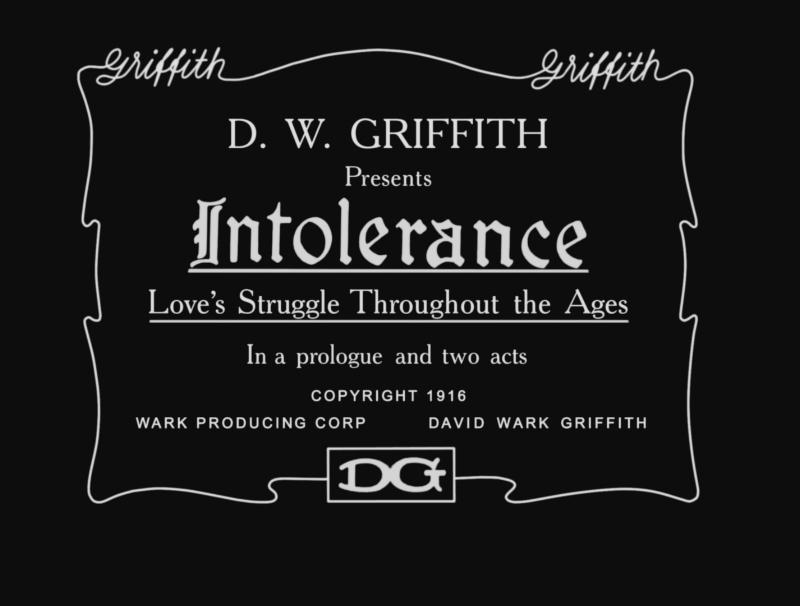
U.S. 1916
Directed by D.W. Griffith
| After
Birth of a Nation, what do you do for an encore, especially
after said film has branded you a racist? D.W. Griffith, the silent
era's "king of the world," mounted this melodramatic spectacle of
"Love's Struggle Throughout the Ages," four stories that illustrate "how
hatred and intolerance have battled against love and charity." Critic
Heywood Broun, upon the film's release, probably said it best: "Quite
the most marvelous thing which has been put on the screen, but as a
theory of life it is trite." But what's on the screen is dazzling! Griffith interweaves the four parallel stories set, respectively, in the modern era (fuddy-duddy reformers and a workers' strike), Jerusalem (Christ's crucifixion), 1572 Paris (a "hotbed" of persecution against the Huguenots), and ancient Babylon. No collection of silent films is complete without this landmark, awe-inspiring epic, which really does boast a cast of thousands (the most memorable of which is Constance Talmadge as the spunky Mountain Girl). The fall of Babylon ranks with one of the great action set pieces, complete with racing chariots, a nifty decapitation (at the hands of Elmo Lincoln, the man who would be Tarzan), and falls from what appear to be incredible heights. The edge-of-your-seat climax to the modern story, a race against time to save an innocent young man from the electric chair, is another bravura sequence. |
Posters
|
|
|
Reviews More Reviews DVD Reviews
DVD Comparison:
Image - Region 0 - NTSC vs. Kino (Masterworks) - Region 0 - NTSC vs. Eureka - Region 0 - PAL
Kino and Eureka screen captures courtesy of Pavel Borodin Thanks Pavel!
(Image - Region 0 - NTSC - LEFT vs. Kino (Masterworks) - Region 0 - NTSC - MIDDLE vs. Eureka - Region 0 - PAL - RIGHT)
| DVD Box Covers |
|
|
|
| NOTE: Purchases through DVDBeaver's links to Amazon help keep us afloat and advertisement free! | |||
| Distribution |
Image Entertainment Region 0 - NTSC |
Kino Video Region 0 - NTSC |
Eureka
Region 0 - PAL |
| Runtime | 2:57:36 | 3:17:13 | 2:57:36 |
| Video |
1.33 Original Aspect Ratio Average Bitrate: 4.42 mb/s NTSC 704x480 29.97 f/s |
1.33 Original Aspect Ratio |
|
NOTE: The Vertical axis represents the bits transferred per second. The Horizontal is the time in minutes. |
|||
| Bitrate:
Image
|
|
||
| Bitrate:
Kino
|
|
||
| Bitrate:
Eureka |
|
||
| Audio | English (Silent) (Dolby Digital 2.0 Stereo) | English (Silent) (Dolby Digital 2.0 Stereo) |
English (Silent) (Dolby Digital 2.0 Stereo) |
| Subtitles | Inter-titles: English | Inter-titles: English | Inter-titles: English |
| Features |
Release Information: Studio: Image Entertainment Theatrical Release Date: September 5, 1916 Aspect Ratio: Edition Details:
DVD Release Date: January 19th, 1999 Chapters 36
|
Release Information: Studio: Kino Video (Griffith Masterworks edition) Theatrical Release Date: September 5, 1916 Aspect Ratio: Full Screen (Standard) - 1.33:1 Sides: 1 Layers: 2 Intertitles: English Studio: Kino International, USA Special Features: • Filmed introduction by Orson Welles • Excerpts from Cabiria (1914) and • The Last Days of Pompeii (1914) • Text excerpts from "Away with • Meddlers: A Declaration of Independence" and "The Rise and Fall of Free Speech in America," two pamphlets published by D.W. Griffith at the time of Intolerance's release • Excerpt of The Fall of Babylon (1916), which offers an alternate (happy) ending to the Babylonian sequence • About the score
DVD
Release Date: December 10th, 2002
Chapters 30
|
Release Information: Studio: Eureka Video (UK) Theatrical Release Date: September 5, 1916 Aspect Ratio: Sides: 1 Chapters 30 |
| Comments: |
What color infusion
tinting would you like your silent films in? Orange?, Blue?, Green?,
Purple? In most shots the Kino masterworks image quality is the sharpest, followed by the Eureka - PAL disc and the original Image Entertainment follows in third place for detail. My biggest problem is with the contrast boosting of the Eureka. It looks awful in comparison... far too bright. Both the Eureka and the Image have been cropped vertically... approximately the same amount. The time is exactly the same for both indicating they are probably from the same print. The Kino is the obvious one to get with more detail and a host of nice extras. NOTE: The Eureka PAL DVD is part of "D. W. Griffith - Monumental Epics" 4-disc Boxset, but should be the same as single edition |

DVD Menus
(Image
- Region 0 - NTSC - LEFT vs. Kino (Masterworks)
- Region 0 - NTSC - MIDDLE vs. Eureka - Region 0 - PAL - RIGHT)
![]() |
|
|
![]() |
|
|
Screen Captures
(Image - Region 0 - NTSC - TOP vs. Kino (Masterworks) - Region 0 - NTSC - MIDDLE vs. Eureka - Region 0 - PAL - BOTTOM)
|
|
![]() |
![]() |
(Image - Region 0 - NTSC - TOP vs. Kino (Masterworks) - Region 0 - NTSC - MIDDLE vs. Eureka - Region 0 - PAL - BOTTOM)
|
|
|
|
![]() |
(Image - Region 0 - NTSC - TOP vs. Kino (Masterworks) - Region 0 - NTSC - MIDDLE vs. Eureka - Region 0 - PAL - BOTTOM)
|
|
|
|
![]() |
(Image - Region 0 - NTSC - TOP vs. Kino (Masterworks) - Region 0 - NTSC - MIDDLE vs. Eureka - Region 0 - PAL - BOTTOM)
|
|
|
|
![]() |
(Image - Region 0 - NTSC - TOP vs. Kino (Masterworks) - Region 0 - NTSC - MIDDLE vs. Eureka - Region 0 - PAL - BOTTOM)
|
|
|
|
![]() |
Report Card: